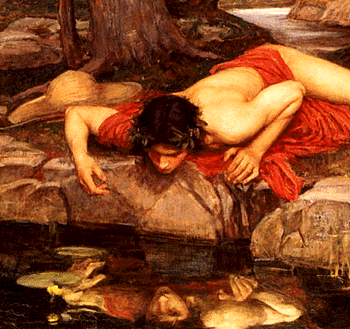
The shift from sacred to courtly
and finally to bourgeois Art is a shift from a collective to a private experience
59. With
the the rise of capitalism the traditional social relations of feudalism became
irrelevant to the bourgeoisie, the anonymity of the market and the development
of waged labour no longer required the cohesive social function of the arts,
the bourgeoisie no longer required or desired social contact with the lower
classes. For the late 19th century bourgeoisie the working class districts of
London were as alien as Conrad's 'Heart Of Darkness'.
The bourgeois revolutions culminated in an Art of individualism and privacy.
The move to individualism took place in both the production and reception
of the work of art . In production this shift begins during the Renaissance
with the decline of the mediaeval craft guilds and the collective workshop,
and the origin of the concept of the 'genius' . In reception this process
can be discerned in the rise of Art forms which isolated the audience as
individuals (the novel, the darkened theatre auditorium) , and also in the
commodification of the aura.
Before the development of the aura of Art, the Sacred and Courtly artwork
had a prestige generated by it's social function; the sacred word, the image
of God, the King's estate, the music for the pageant, the chapel of the
Lord, the palace....etc.
To borrow Wollen's semiotic model, prestige emanates from the referent,
prestige lies not in the artwork itself nor in the maker, prestige is derived
from the feudal hierarchy of God and Monarch. The prestige of a painting
of Christ emanates from the son of God not from the painting or the artist.
As Victor Burgin notes:
' In the Middle Ages, to speak of the 'creativity' of the artist would have
been to risk burning as a heretic-there was only one Creator.' 60
It is only with the advent of Renaissance humanism that the work of art begins
to become the work of an individual mortal 61,
before the Renaissance art was the work of God and the artist was simply a medium
for God's divine creation. After the Renaissance the artist began to develop
as an individual with a personal expression and style.
The function of Courtly art was to represent the glory of the monarch, the
nobility and the reign of the court. The prestige of Courtly art emanates
from the monarchy and the nobility who also legitimise their authority in
the name of God. And so in both Sacred and Courtly art prestige is a function
of the artwork in that it is the distance of the viewer from sacred
and noble authority, it locates the viewer in the great cosmic feudal hierarchy
which begins at it's highest with God and then descends by degree through
every angel , every human, from King to serf, every beast and finally to
the basest elements of existence.
With the development of bourgeois autonomous Art, the prestige of Sacred
and Courtly art becomes autonomous, it becomes aura ; prestige without 'function'.
In the presence of the great Art work the modern bourgeoisie are alone,
they experience the aura as a fascinating nostalgia, an ineffable exaltation
and regret: exaltation that they are at last in the presence of noble and
sacred tradition, and the regret that they have commodified and so rendered
the tradition superfluous. For this reason the Art gallery has become both
the church and palace of the aura and for this reason Art eventually divested
itself of even the function of representation, as Burger notes:
'The solitary absorption in the work is the adequate mode of appropriation
of creations removed from the life praxis of the bourgeois, even though they
still claim to interpret that praxis. In Aestheticism, finally, where bourgeois
art reaches the stage of self -reflection, this claim is no longer made. Apartness
from the praxis of life, which had always been the condition that characterised
the way art functioned in bourgeois society, now becomes its content."
62
Here Burger's insight is telling but his formulation needs revision, since
as I think you now realise, bourgeois Art is in no way 'removed from the
life praxis of the bourgeois'. As I observed earlier Wollen, Poggioli and
Burger all more or less share a conception of non-representational Art
as the defining development of the Avant-Garde and it is also implicit in all
three texts that the Avant-Garde is the defining tendency of modern Art. This
observation opens once more a confusion between Modernism and the Avant-Garde.
Let us then agree with Wollen's 'Two Avant-Gardes' and also with the re-definition
of that article by Willeman
63 , that Modernism is the movement in Art that pursues the rift
opened up between signifier and signified. However, let us abandon the breakthroughs
and coupures . The process of separation between the signifier and the
signified, which inevitably leads to the suppression of the signified, to an
Art of pure signifiers 64
, is the autonomisation of the content of Art. If the Avant-Garde is the vanguard
of autonomous bourgeois Art, so Modernism is it's realisation as content. This
gradual process can be traced through the rise of bourgeois Art to it's first
articulation in the Art for Art Sake movement, a semiotic denial of the referent
which permits the rift between signifier and signified in Cubism. Modernism
then is the Art of the Abstract, the Non-Objective, the Non-Representational
and the Non-Narrative. The Modernist Artist eliminates content and decoration
65 , and
seeks purity of form and material. This compulsion is driven by the fetish of
the aura, for as mechanical reproduction becomes ever more mimetically efficient,
so aura as a commodity becomes ever more specialised as that which cannot be
mechanically reproduced; throughout the 19th century new industrial techniques
of fabrication undermine Art's function as the producer of beautiful objects
whilst photography erodes Art as the representation of the real. Inevitably
the only thing that cannot be mechanically reproduced is aura itself, abstract
and superfluous.
This elimination of representation is a 'breakthrough' in the development
of the aesthetic of bourgeois Art, it is pure aura, the fetish of Sacred
and Courtly authority in its ideal state, form without 'content', beauty
without purpose. And this is it's purpose, for this pure Art can only be
appreciated by the the social elite, as Bourdieu notes in Distinction ,
A Social Critique of the Judgement of Taste (1979):
'....Never perhaps has more been asked of the spectator, who is now required
to 're- produce' the primary operation whereby the artist (with the complexity
of his whole intellectual field ) produced this new fetish. But never perhaps
has he been given so much in return. The naive exhibitionism of 'conspicuous
consumption', which seeks distinction in the crude display of ill-mastered luxury,
is nothing compared to the unique capacity of the pure gaze, a quasi-creative
power which sets the aesthete apart from the common herd by a radical difference
which seems to be inscribed in 'persons'. 66
If the function of sacred and courtly art is to articulate the social hierarchy
of feudalism , then the 'function' of the superfluousness of autonomous
bourgeois Art is to articulate the social hierarchy of bourgeois capitalism.
This is the irrational and complex autonomy of bourgeois Art. Art demonstrates
to society that the bourgeoisie now has sacred and noble authority, but
to gain this authority the bourgeoisie hasabstracted it from its
tradition, it's function, they have commodified the aura and they have developed
a realm of beauty free from necessity, and this freedom from human need,
this life of ease has become the aesthetic of Art.
' The pure gaze implies a break with the ordinary attitude towards the world
which, as such is a social break. One can agree with Ortega y Gasset when he
attributes to modern art-which merely takes to its extreme conclusions an intention
implicit in art since the Renaissance-a systematic refusal of all that is 'human'
, by which he means the passions, emotions and feelings which ordinary people
put into their ordinary existence, and consequently all the themes and objects
evoking them' 67
The gaze of Art eliminates function and replaces it with aesthetics,
this gaze rejects the base and venal pleasures of the body, the vulgar entertainments
of the masses, the recklessness of political action, the vulnerability of
emotion. In the silent gallery the viewer is never lost, but remains amused
with their own perception. This impartiality fixes the superiority of the
bourgeois as those who have risen above not only the animal passions
of the lower
classes but also the superstition of Christianity and the primitive bloodline
of the aristocracy.
This ascendance is the content of Modernism; function, representation and
affection are all purged, the autonomy of Art becomes both the form and
content of the Artwork; pure aura.
Which of course is the terrible irony of Modernism and the Avant-Garde,
because the Avant-Garde is not the spearhead of a radical new future, it
is the means by which the bourgeoisie perpetuate the social hierarchy of
feudalism.
And Modernism is not modern socially, technologically or industrially
, it is the survival of a feudal handicraft into the age of mechanical reproduction.
This is the paradox of autonomisation as a process which eliminates the
human from the work of Art, for as the human is refused as content,
so it becomes the guarantee of aura, as mechanical reproduction becomes
ever more efficient so what cannot be reproduced becomes ever more fetishized,
which is to say that the humanity of the Artist becomes fetishized as the
referent of the aura.